DTCP vs CMDA Approval: How to Check a Chennai Plot
By the Valuepersqft advisory team ·

Almost every plot advertisement in Chennai carries one of two words in large letters: DTCP or CMDA. Buyers tend to treat them as a stamp of quality, and sellers are happy to let them. In reality they tell you something narrower and more useful: which government body approved the layout, and therefore where you should go to check that the approval is real and covers the plot you are buying. Here is DTCP vs CMDA approval in plain words.
At a glance- CMDA approves layouts inside the Chennai Metropolitan Area; DTCP approves them in the rest of Tamil Nadu.
- Neither is better: what matters is that the right body approved the layout and your plot is on the plan.
- Check the approval yourself on the state's online planning portal before paying anything.
- Patta, chitta, the encumbrance certificate and a 30-year title chain prove ownership; the approval does not.
This guide explains the difference in plain terms, walks you through checking an approval online, lists the land papers that matter in Tamil Nadu, and ends with the gated plot communities we track on our plots in Chennai page. It is written for families who want to build their own home one day, not for quick trading.
DTCP or CMDA: who approves what
Both bodies work under the same law, the Tamil Nadu Town and Country Planning Act, 1971, and follow the same building and layout rules. What separates them is geography.
- CMDA, the Chennai Metropolitan Development Authority, is the planning authority for land inside the Chennai Metropolitan Area. If your plot falls inside that boundary, the layout needs CMDA approval.
- DTCP, the Directorate of Town and Country Planning, approves layouts in the rest of Tamil Nadu, outside the metropolitan area.
So a DTCP layout is not better or worse than a CMDA one. A DTCP approval on land that actually sits inside the metropolitan area, though, would be a red flag, because the wrong body would have approved it. The metropolitan boundary has been widened in the past and the state has proposed widening it again, so always check the jurisdiction for the specific survey number rather than relying on what was true a few years ago.
Why the approval matters so much for a plot
With an apartment, you are buying into a building that has its own planning permission and, eventually, a completion certificate. With a plot, the layout approval is almost the whole story. It decides:
- Whether you can get a building permit. Local bodies issue building plan approval only for plots in approved layouts or regularised ones.
- Whether banks will lend. Most lenders will not fund a plot purchase or a construction loan in an unapproved layout.
- What the roads and open spaces will be. The approved plan fixes road widths and the open space reservation, usually around 10 percent of the layout, which must be handed over to the local body and cannot later be sold as plots.
- How easily you can sell later. Future buyers and their lawyers will ask the same questions you are asking now.
How to check a layout approval online
Tamil Nadu runs a single-window planning portal for both CMDA and DTCP approvals at onlineppa.tn.gov.in. The check takes about ten minutes.
- Ask the seller, in writing, for the layout approval number, the year and the approving office. It usually appears as an LP (layout permit) number.
- On the portal, open the layout approval verification option and search by approval number, choosing the same office the seller named.
- Compare what the portal shows with the brochure and the sale agreement: the layout name, survey numbers, total extent, number of plots, road widths and the open space.
- Find your plot number on the approved layout plan. Check that its size and position match what you are being sold.
- Walk the site. Pace the internal roads and look for the open space on the ground. Approved roads cannot be narrowed later, and open space should be visible, not fenced into someone’s plot.
If the search returns nothing, do not panic straight away: a wrong office or year is the most common reason. But do not pay anything until the record is found and matches.
The land papers that matter in Tamil Nadu
An approved layout tells you the land was planned properly. It does not prove the seller owns it. For that, your lawyer will look at the following, and you should ask for copies before paying an advance.
- Title deeds and the parent documents, ideally tracing ownership back around 30 years, so you can see how the land passed from one owner to the next.
- Patta and chitta, the revenue records that show who the land is registered to and its classification. These can be viewed online through the state’s e-services portal. The name should match the seller or the developer’s land-owning entity.
- Encumbrance certificate (EC) from the registration department’s TNREGINET portal, covering the same 30-year period. It lists registered transactions on the land, including mortgages.
- FMB sketch, the field map of the survey number, which helps confirm boundaries.
- Guideline value for the street, also on TNREGINET. Stamp duty and registration charges are calculated on the higher of the guideline value and the sale price.
After you buy, apply for patta transfer into your name. Many buyers forget this step, and it causes trouble later when they apply for a building permit or a loan.
RERA registration for plotted layouts
Plotted developments come under the real estate law just as apartments do. A layout above 500 square metres or with more than eight plots should be registered with the Tamil Nadu Real Estate Regulatory Authority before it is advertised or sold. TNRERA has tightened its scrutiny of layout registrations in 2026, asking developers to show that land records, approvals and the infrastructure on the ground all match. Search the project on the TNRERA website and compare the plot count, extent and completion date with what you are told.
Unapproved layouts and regularisation
You will come across plots, often cheaper, in layouts that were never approved. Tamil Nadu has a scheme to regularise such plots, and in 2025 the state removed its end date. But it applies only to plots bought before 20 October 2016, and the owner has to pay regularisation charges and meet open space conditions. For a buyer today, that means an unapproved layout cannot simply be fixed later. We do not recommend these plots to our clients, whatever the price.
Gated plot communities compared
Here are some of the larger plotted communities we track around Chennai. “Plots per acre” divides the number of plots by the land area, a quick guide to how much land goes into roads, parks and amenities rather than plots.
| Community | Area | Land | Plots | Plots per acre | Plot sizes (sq ft) |
|---|---|---|---|---|---|
| Urbanrise Opus96 | Tambaram | 96 acres | 900+ | about 9 | 1,500 to 2,400 |
| Hiranandani Loftline | Thaiyur | 22 acres | 253 | about 12 | 1,809 to 4,009 |
| Pacifica Enchante | Siruseri | 25 acres | 392 | about 16 | 1,200 to 2,400 |
| Casagrand Uptown | Poonamallee | 30 acres | 471 | about 16 | 1,500 to 2,385 |
| Mahindra World City Plots | GST Road | 19 acres | 300 | about 16 | 1,500 to 4,000 |
| Godrej Sunrise Estate | Oragadam | 60 acres | 975 | about 16 | 1,500 to 2,400 |
| DLF Parc Estate | Siruseri | 87.5 acres | 1,509 | about 17 | 1,500 to 2,800 |
| Purva Soukhyam | Guduvancheri | 120 acres | 2,200 | about 18 | 1,655 to 5,082 |
| Purva Raagam | Thirumazhisai | 33 acres | 650 | about 20 | 1,200 to 3,850 |
| VGN Grandeur | Porur | 27.9 acres | 563 | about 20 | 1,200 to 2,000 |
Two patterns are worth noticing. The largest plot sizes, over 4,000 sq ft, sit in communities with fewer plots per acre, such as Hiranandani Loftline and Purva Soukhyam, which suits families planning a large independent home. And the big branded townships are almost all on the city’s edges, along OMR’s southern end, GST Road and the west, because that is where land parcels of 50 acres and more still exist.
Figures are as published by the developers on our project pages and may change between phases.
Plot communities we track around Chennai
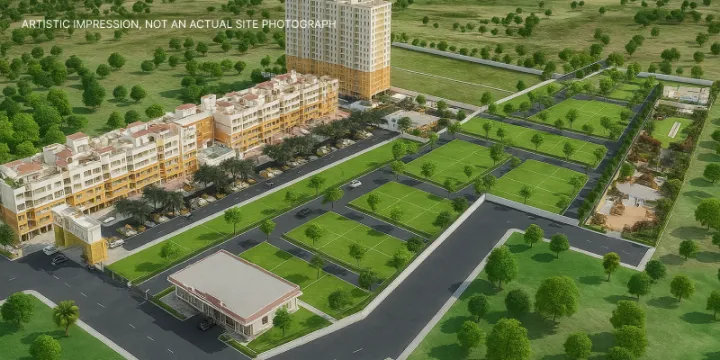
A large 87.5-acre plotted township close to SIPCOT IT Park, with plots of about 1,500 to 2,800 sq ft.

253 plots on 22 acres, with some of the larger plot sizes on OMR, up to about 4,000 sq ft.
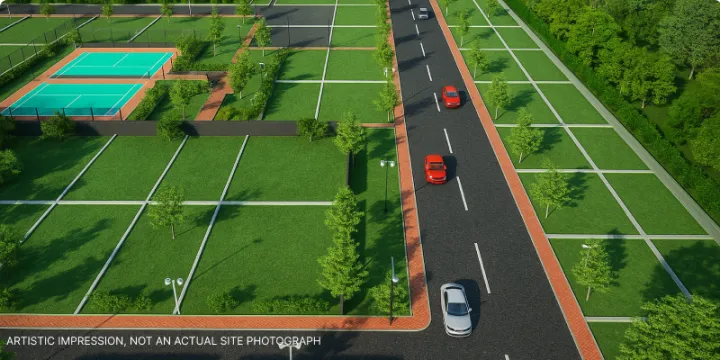
300 plots on 19 acres within the larger Mahindra World City, with sizes up to about 4,000 sq ft. Developer: Mahindra.
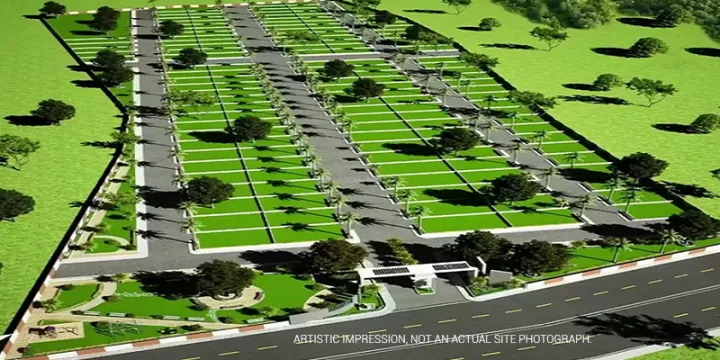
A 120-acre township off GST Road with a very wide range of plot sizes, up to about 5,000 sq ft. Developer: Purva.
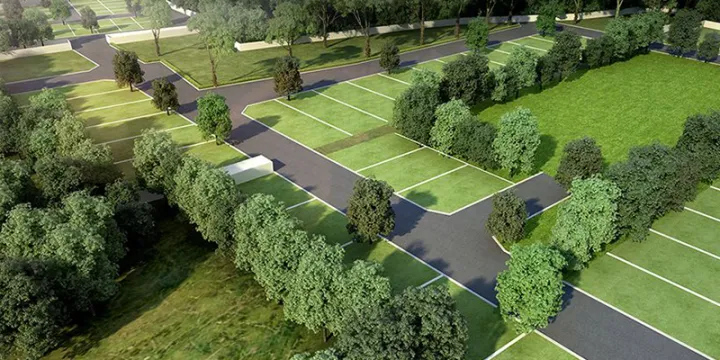
471 plots on 30 acres in the west, close to the Porur and Poonamallee belt. Developer: Casagrand.
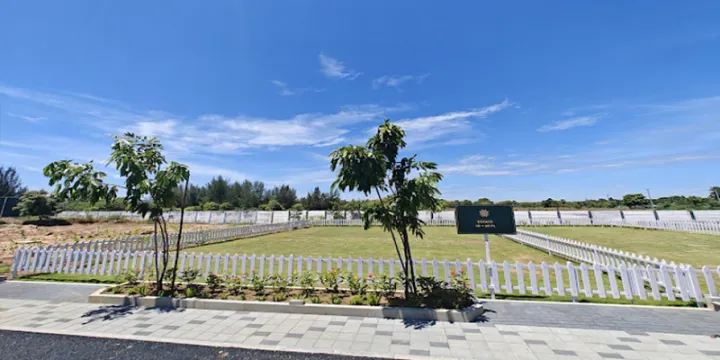
975 plots on 60 acres in Chennai’s industrial and automobile belt, with sizes of about 1,500 to 2,400 sq ft. Developer: Godrej.
Also on our list: Pacifica Enchante in Siruseri, Urbanrise Opus96 near Tambaram, TVH Bloom near Sholinganallur, Purva South Bay at Kelambakkam, Purva Raagam and VGN Grandeur in the west. The full list is on our Chennai plots page.
Where Chennai’s plot communities are
OMR’s southern end: Siruseri, Thaiyur and Kelambakkam
This is where plots meet jobs. SIPCOT IT Park at Siruseri is close by, schools and hospitals have filled in over the last decade, and the beaches of East Coast Road are a short drive across. It suits IT professionals who want to build near work. Our OMR page and our guide to living near Chennai’s OMR tech parks cover the corridor in detail.
GST Road: Guduvancheri, Mahindra World City and beyond
The Grand Southern Trunk Road has suburban rail, a national highway and large employers, including the industrial and IT zones at Mahindra World City. Townships here are big and well planned. Commutes to the city centre are longer, so this suits families who work on the southern side.
The west: Poonamallee, Porur and Thirumazhisai
The west has grown on the back of the Porur and Poonamallee belt, the Chennai Bypass and the new metro line along the Poonamallee road. It suits buyers with work in Guindy, Porur’s offices or the industrial belt towards Sriperumbudur.
Oragadam and Sriperumbudur
This is Chennai’s automobile and manufacturing heartland. Plot communities here suit people working in the industrial parks and long-term buyers comfortable with a quieter, still-developing area.
Building on your plot: what to expect
Buying the plot is step one. If you plan to build, allow time for the following.
- Patta transfer into your name, which you will need for almost everything after.
- Building plan approval from the local body, or from CMDA or DTCP for larger buildings. Gated communities often have their own design guidelines too, covering height, setbacks and boundary walls.
- Soil testing and design, especially in low-lying parts of the city, where the plinth level should sit well above the road.
- Construction, typically 12 to 18 months for an independent house once approvals are in hand.
Some plotted communities offer a build-on-your-plot service through the developer or tied-up contractors. It is worth asking about even if you plan to use your own architect, because it shows how seriously the developer takes the community after the plots are sold.
A site visit checklist for Chennai plots
- Is the layout approval number on the brochure, and does it match the portal record?
- Is the project registered with TNRERA, with the same plot count and extent?
- Are the roads laid to the approved width, with stormwater drains on both sides?
- Is the open space reservation visible and handed over, or at least clearly marked?
- Where will water come from: borewells, a treatment plant, or a municipal connection?
- Has the site or the approach road flooded in recent monsoons? Ask neighbours, not only the sales team.
- Do patta, EC and the title chain all name the same land and the same owner?
What we tell our clients
An approved layout in a well-run gated community is one of the cleanest ways to own land in Chennai. Check the approval yourself, have a lawyer read the title and the EC, and walk the site after rain before you commit. If you would like help comparing plotted communities on these points, our Chennai team can put a shortlist together and go through the papers with you.
Talk to a Chennai plot advisor →
Frequently asked questions
What does DTCP approved mean?
It means the Directorate of Town and Country Planning has approved the layout plan, including plot sizes, roads and open space. DTCP approves layouts in Tamil Nadu outside the Chennai Metropolitan Area.
Is CMDA approval better than DTCP approval?
Neither is better. The right approval depends on where the land is. Inside the Chennai Metropolitan Area it should be CMDA; outside it, DTCP. What matters is that the correct body approved the layout and that your plot appears on the approved plan.
How can I check if a plot is DTCP or CMDA approved?
Ask for the layout approval number and year, then search it on the state’s online planning permission portal. Check that the layout name, survey numbers, plot count and road widths match.
Can I get a bank loan for a plot in Chennai?
Most banks lend for plots in approved layouts, often with a condition that you build within a set period. Loans for plots in unapproved layouts are rarely available.
Can an unapproved plot be regularised?
Only if it was bought before 20 October 2016, under the state’s regularisation scheme, and after paying the charges. Plots bought after that date in unapproved layouts cannot use the scheme.
Which documents should I check before buying a plot in Chennai?
The layout approval, TNRERA registration, title deeds going back around 30 years, patta and chitta, the encumbrance certificate, the FMB sketch and the guideline value for the street.
More guides from our advisors- Where to Live Near OMR IT Parks in Chennai
- Chennai vs Bangalore vs Hyderabad: Where to Buy
- How NRIs Can Buy Property in India
By the Valuepersqft advisory team Property advisors across Bengaluru, Hyderabad, Chennai, Pune and Mumbai for 8+ years, working with 40+ developers and 500+ projects.
This article is general guidance, not legal advice. Rules and portals change; please confirm current requirements with a property lawyer and our team before making a decision. Project details are taken from developer information and may change.
Talk to a Valuepersqft advisor
Honest, unbiased property advice. Call +91 6366229758, email support@valuepersqft.com or book a free consultation.
Offices: Whitefield, Bengaluru · Nanakramguda, Hyderabad · Manapakkam, Chennai · Kharadi, Pune.